Field manual · September 21, 2026
Castle Busters Tier List: Verified Roles, Not Guesswork
Use a source-bounded Castle Busters tier list that separates documented roles from unknown stats and shows what to test before ranking a unit.
A defensible all-unit S-to-D list is not yet possible: the official site says 30+ units but publicly documents only a subset and no complete current stat table. Use verified role fit and repeatable tests now; add performance tiers only when comparable evidence exists.
Field order
Current evidence tier
This page ranks confidence in the public evidence, not hidden combat power. A unit enters the verified tier when an official page explains its attack or ability. A named-only unit remains unranked until its behavior and current version can be checked.
That distinction prevents a popular search label from turning missing stats into false precision. It also gives the page a clear update rule: add a performance tier only after equivalent units have been tested against the same target, version and formation.
| Evidence tier | Units | What is safe to use |
|---|---|---|
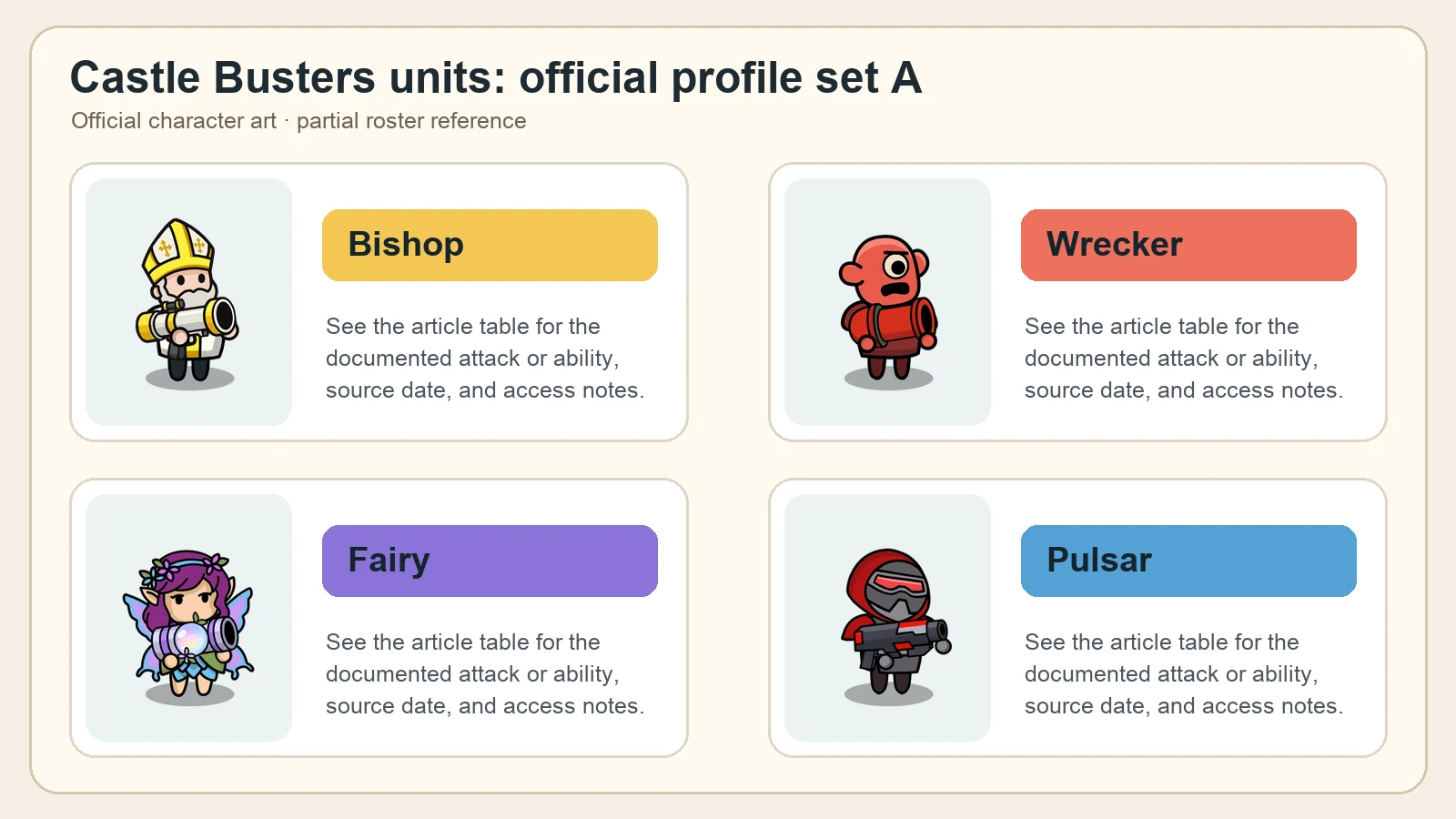
| Verified ability | Bishop, Wrecker, Fairy, Pulsar, Saxton, Sir Rally, Leif, Wolfie, Graves | Officially described attack or ability; still verify current values |
| Named only | Vampire | Identity in a patch note; no ability or performance claim |
| Unpublished remainder | Other units inside the official 30+ claim | Do not invent names, stats, roles or ranks |
Field order
Choose by the failure you need to fix
Wrecker offers documented area damage, Pulsar an accurate laser, Saxton returning boomerangs, Bishop delayed detonation and Fairy falling destructive orbs. These descriptions help form a testable hypothesis; they do not reveal which unit wins every matchup.
Sir Rally, Leif and Wolfie are placement-sensitive. Graves creates persistent board objects. Put those conditions into the formation before comparing damage, because a failed trigger can make a strong mechanic look weak.
| Observed problem | Candidate mechanic | First check |
|---|---|---|
| Grouped targets survive | Wrecker area damage or Fairy falling orbs | Can the attack reach the cluster in this formation? |
| A precise lane or target matters | Pulsar laser or Saxton return path | Does the line stay open through the decisive turn? |
| Adjacent allies need support | Sir Rally | Are the intended allies immediately around him? |
| Board pressure persists between turns | Graves | Do settled graves survive and target exposed units? |
Field order
Performance-tier admission rule
To move a unit into an S, A, B or lower performance tier, record the current patch, target, castle state, formation, upgrade level and at least two comparable results. Compare only units tested for the same job. A damage unit and a placement support should not share one raw-damage ranking.
Patch 1.18 changes Wolfie and foundation behavior, so pre-1.18 conclusions involving those systems need a new baseline. A later patch can invalidate the list again; retain the dated result instead of silently overwriting it.
Field order
Build a useful team without a fake universal list
Start with the eight-unit cap. Cover a dependable damage path, a response to clustered or exposed targets, and any support trigger your formation can activate. Leave room to replace one slot after observing the first failure.
If a copied list does not state its version, upgrades, opponent and formation, treat it as a candidate test rather than an answer. The best current tier-list action is the smallest controlled comparison that could change your next slot.
Records